
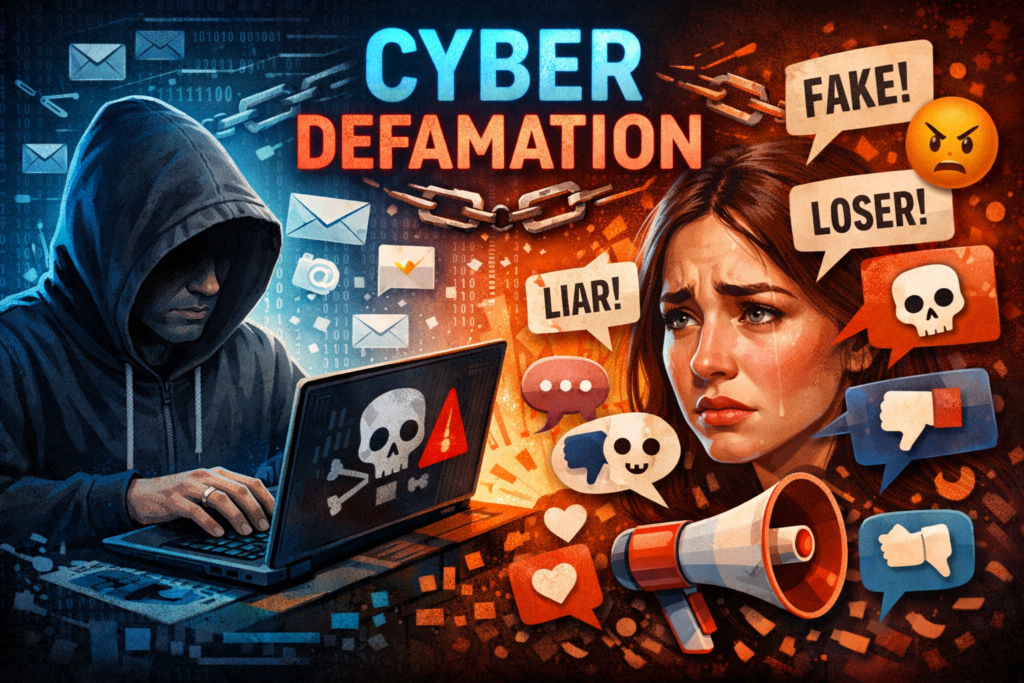
Online attacks on reputation can escalate quickly, causing serious personal and professional harm. False statements, misleading claims, and malicious posts can spread across platforms within minutes, making damage difficult to control. Cyber defamation in India demands prompt legal attention and a strategic response. Our legal service focuses on protecting your reputation through precise legal action against online defamation, ensuring your rights are enforced, evidence is preserved, and responsible parties are held accountable through effective remedies under cyber defamation law.
What is Cyber Defamation?
Cyber defamation has emerged as one of the most pressing legal challenges in the digital ecosystem. Individuals and businesses face increasing threats from false statements published across digital channels, leading to severe reputational and financial consequences. Unlike traditional forms of defamation, online content spreads rapidly, remains accessible for extended periods, and often reaches a global audience. This makes timely legal intervention not just important but essential.
The Expanding Scope of Digital Harm
The rise of digital communication has transformed how defamatory content is created and distributed. Written posts, shared messages, edited visuals, and forwarded claims can all contribute to online defamation cases. The law recognizes that harm caused in the digital space is just as serious as harm caused offline, if not more damaging due to its scale and permanence.
Cyber defamation law addresses wrongful acts where false statements harm a person’s reputation through online channels. This includes both cyber libel and slander, covering written and spoken forms of defamation shared digitally. Courts increasingly recognize that online false allegations and legal action must be treated with urgency due to the speed at which harm multiplies.
Why Cyber Defamation Requires Immediate Action?
Delays in responding to defamatory content can worsen the impact. Search engines index content, social platforms amplify it, and users continue sharing it. Legal professionals handling cyber defamation in India focus on rapid response strategies to minimize damage and initiate corrective legal measures.
Key risks of delayed action include:
- Content reaching wider audiences and becoming viral
- Increased difficulty in removing defamatory material
- Greater financial and reputational loss
- Loss of crucial digital evidence
- Complications in proving intent and authorship
Common Forms of Cyber Defamation
Cyber defamation takes multiple forms, each requiring a tailored legal approach. Recognizing these forms helps in identifying violations early and initiating appropriate legal remedies.
Some common forms include:
- Defamation on social media platforms through posts, comments, or shares
- Defamation through email or messages sent to individuals or groups
- Defamation on WhatsApp and Facebook via forwarded content
- Publication of misleading or false claims on blogs or websites
- Anonymous posts targeting individuals or businesses
- Coordinated attacks intended to damage the online reputation
These acts often fall under cyber harassment and defamation laws, especially when repeated or targeted.
Legal Recognition and Enforcement
Indian courts and law enforcement agencies have strengthened their approach toward the cybercrime defamation complaint process. Legal provisions now enable victims to take swift action against offenders, whether known or anonymous. Authorities can trace IP addresses, request platform cooperation, and issue takedown notices when required.
Legal action against online defamation may involve:
- Filing complaints with cybercrime cells
- Initiating civil suits for damages
- Pursuing criminal charges under applicable laws
- Seeking court orders for content removal
- Demanding public retractions or apologies
Each step requires careful documentation and legal precision to ensure success.
Business and Individual Vulnerability
Cyber defamation does not discriminate between individuals and organizations. Professionals, entrepreneurs, and companies are equally vulnerable to reputation attacks. A single defamatory post can impact credibility, client trust, and long-term growth.
Typical consequences include:
- Loss of professional credibility
- Decline in business opportunities
- Emotional distress and anxiety
- Damage to brand image and goodwill
- Financial losses due to reduced trust
This makes online reputation damage legal help an essential service rather than a reactive option.
Strategic Legal Response
A structured legal approach ensures that victims regain control over their reputation. Legal experts assess the situation, identify violations, and implement a combination of legal and technical measures to address the issue.
A well-planned response includes:
- Identifying defamatory content and its source
- Evaluating applicable cyber defamation law provisions
- Collecting and securing digital evidence
- Initiating takedown procedures
- Filing complaints and pursuing legal remedies
- Advising on reputation management for defamation
What is Defamation in the Digital Age?
Defamation in the digital age refers to the act of making false statements about a person or entity through online channels, causing harm to their reputation. The shift from traditional communication to digital platforms has expanded both the reach and impact of defamatory content. A single post, message, or upload can influence opinions, damage credibility, and trigger long-term consequences within hours.
Defamation Redefined by Technology
Digital platforms have transformed how information is created, shared, and consumed. Unlike offline communication, online content remains searchable, shareable, and often permanent. This permanence amplifies the seriousness of online defamation cases, making legal intervention essential.
Defamation in the digital context includes:
- Written false statements published on websites or blogs
- Harmful comments or posts shared publicly
- Circulated claims through messaging applications
- Reposted or reshared defamatory content
- Misleading content targeting individuals or businesses
Such acts fall within the scope of cyber libel and slander, depending on the form and method of communication.
Key Characteristics of Digital Defamation
Digital defamation differs significantly due to its unique characteristics. These features increase both the complexity of cases and the urgency of legal response.
Important characteristics include:
- Instant publication to large audiences
- Ease of sharing across multiple platforms
- Difficulty in controlling or deleting content
- Possibility of anonymous or fake accounts
- Long-term visibility through search engines
These elements make legal action against online defamation more complex but also more necessary.
Legal Perspective on Online Defamation
From a legal standpoint, defamation in digital environments still requires the same foundational elements: a false statement, publication to a third party, and reputational harm. However, courts now interpret these elements within the framework of digital communication.
Cyber defamation law recognizes:
- Online posts as valid forms of publication
- Digital messages as evidence in court
- Platform activity as traceable conduct
- Repeated sharing as an extended publication
Legal authorities treat defamation on social media platforms with seriousness, especially when it results in widespread damage.
Forms of Digital Defamation
Digital defamation manifests in various ways, each requiring careful legal evaluation. The nature of the content, its intent, and its reach all influence how the law applies.
Common forms include:
- Defamation through email or messages targeting individuals
- Defamation on WhatsApp and Facebook through forwarded content
- Public posts containing false allegations
- Edited or manipulated content shared online
- Anonymous accounts are spreading misleading claims
These scenarios often overlap with cyber harassment and defamation laws, especially when they involve repeated or targeted behavior.
Impact on Reputation and Identity
Reputation is closely tied to digital presence. Individuals and businesses rely on online credibility for professional growth, partnerships, and public perception. Defamatory content can disrupt this balance instantly.
Consequences may include:
- Loss of trust among clients or peers
- Negative public perception affecting opportunities
- Emotional distress and personal harm
- Reduced visibility due to search engine results
- Long-term damage to personal or brand identity
This makes online reputation damage legal help a critical requirement rather than an optional step.
Digital Evidence and Legal Action
One of the defining aspects of digital defamation is the availability of electronic evidence. Screenshots, URLs, timestamps, and server data play a crucial role in proving claims.
Essential evidence types include:
- Screenshots of defamatory content
- Links to published material
- Records of messages or emails
- Metadata showing time and origin
- Platform activity logs
Proper handling of this evidence is vital in the cybercrime defamation complaint process.
When Legal Action Becomes Necessary
Not every negative comment qualifies as defamation. The law distinguishes between opinion and false factual statements. However, when statements cross into false allegations that harm reputation, legal action becomes necessary.
Situations requiring legal attention include:
- False accusations affecting professional standing
- Malicious campaigns targeting individuals or brands
- Repeated defamatory messages or posts
- Content causing measurable financial or reputational harm
- Intentional spread of misleading information
In such cases, internet defamation legal remedies provide structured solutions to address harm and seek justice.
Difference Between Cyber Defamation and Traditional Defamation
Defamation has long existed as a legal wrong, but its transformation in the digital space has introduced new complexities, risks, and legal considerations. While the core principle remains the same—protecting reputation from false statements—the method of communication significantly alters how the law is applied and enforced. Recognizing the difference between cyber defamation and traditional defamation is essential for determining the right legal strategy.
Core Distinction Between Offline and Online Defamation
Traditional defamation typically occurs through spoken words, printed publications, or broadcast media. In contrast, cyber defamation takes place across digital platforms, where information spreads faster and reaches a wider audience. This distinction impacts how online defamation cases are investigated, proven, and resolved.
Key differences include:
- Medium of communication: physical vs. digital
- Speed of dissemination: limited vs. instant
- Audience reach: localized vs. global
- Content lifespan: temporary vs. long-lasting
- Traceability: identifiable vs. potentially anonymous
These differences directly influence legal action against online defamation and the remedies available.
Speed and Virality of Content
One of the most critical differences lies in how quickly defamatory content spreads. Traditional defamation may take time to circulate, whereas digital content can go viral within minutes. This rapid spread intensifies reputational damage and increases the urgency for legal intervention.
In cyber defamation:
- Content can be shared repeatedly across platforms
- Algorithms amplify visibility automatically
- Users unknowingly contribute to spreading false claims
- Removal becomes more complex once content circulates widely
This makes internet defamation legal remedies more time-sensitive and strategically important.
Permanence and Accessibility
Traditional defamatory statements often fade unless preserved in records. Digital content, however, remains accessible indefinitely unless actively removed. Search engines index content, making it visible long after publication.
Key concerns include:
- Archived posts remaining accessible
- Cached pages retain removed content
- Screenshots preserving deleted material
- Continuous resurfacing through searches
This permanence increases the legal consequences of online defamation and demands proactive legal measures.
Anonymity and Identification Challenges
Traditional defamation usually involves identifiable individuals or entities. Cyber defamation, however, often involves anonymous or fake profiles, making it harder to identify the source.
Challenges include:
- Use of pseudonyms or fake accounts
- Masked IP addresses or VPN usage
- Cross-border digital activity
- Platform privacy restrictions
Despite these challenges, cyber defamation law allows authorities to trace offenders through technical and legal channels. Legal experts play a crucial role in navigating this process effectively.
Evidence Collection and Proof
The nature of evidence differs significantly between traditional and digital defamation. Digital cases rely heavily on electronic records, which require proper collection and preservation.
In cyber defamation in India, evidence may include:
- Screenshots of defamatory content
- URLs and timestamps
- Message logs from platforms
- Email records in cases of defamation through email or messages
- Data retrieved through legal requests
Unlike traditional cases, digital evidence must be authenticated carefully to ensure admissibility in court.
Legal Framework and Application
Traditional defamation is primarily governed by provisions under the Indian Penal Code. Cyber defamation, however, involves a combination of laws, including defamation under the IT Act of India and other applicable statutes.
Legal frameworks for cyber defamation address:
- Online publication of defamatory content
- Platform liability and intermediary responsibilities
- Cross-platform dissemination of harmful statements
- Enforcement through cybercrime units
This layered legal structure requires specialized knowledge to initiate effective legal action.
Impact on Victims
The consequences of cyber defamation often exceed those of traditional defamation due to its scale and persistence. Individuals and businesses face immediate and widespread damage.
Common impacts include:
- Rapid loss of public trust
- Damage to professional credibility
- Emotional and psychological distress
- Financial losses due to reputational harm
- Long-term visibility of defamatory content
This makes online reputation damage legal help a critical step for recovery and protection.
Response Strategy Differences
Responding to traditional defamation may involve notices or court proceedings. Cyber defamation requires a more dynamic and multi-layered approach.
Effective response strategies include:
- Immediate identification of defamatory content
- Initiating takedown requests with platforms
- Filing complaints under the cybercrime defamation complaint process
- Pursuing civil and criminal remedies
- Implementing reputation management for defamation
A structured response ensures both the removal of harmful content and accountability of the offender.
Types of Cyber Defamation
Cyber defamation is not a single, uniform act. It appears in multiple forms across digital platforms, each with distinct legal implications and strategic responses. Identifying the exact type of cyber defamation is critical for initiating the right legal action against online defamation and ensuring that remedies are both effective and enforceable. A well-defined classification also strengthens your position in online defamation cases by aligning facts with applicable provisions under cyber defamation law.
Classification Based on Content Format
Digital communication allows defamatory content to take various formats. Each format influences how the law interprets intent, publication, and harm.
Common content-based types include:
- Text-based defamation: False statements published through posts, comments, or articles
- Image-based defamation: Misleading visuals or edited images shared online
- Video-based defamation: Recorded or live content containing harmful allegations
- Audio-based defamation: Voice messages or recordings circulated digitally
- Document-based defamation: Circulation of manipulated or false documents
These formats fall under cyber libel and slander depending on whether the content is written, recorded, or spoken.
Platform-Specific Cyber Defamation
The platform used to publish defamatory content plays a major role in determining legal strategy. Different platforms have varying policies, traceability mechanisms, and response timelines.
Key platform-based types include:
- Defamation on social media platforms through public posts or comments
- Defamation on WhatsApp and Facebook via forwarded messages or group sharing
- Defamation through email or messages targeting individuals or professional networks
- Website or blog-based defamation where content is published for public access
- Forum or discussion board defamation involving anonymous or pseudonymous users
Each scenario requires tailored internet defamation legal remedies and platform-specific takedown actions.
Intent-Based Categories
The intention behind defamatory content significantly affects legal consequences. Courts often examine whether the act was deliberate, reckless, or negligent.
Intent-based types include:
- Malicious defamation: Content created with clear intent to harm reputation
- Reckless defamation: Publishing unverified claims without concern for truth
- Negligent defamation: Sharing false information without proper verification
- Targeted defamation campaigns: Coordinated efforts to damage credibility
- Repeated defamatory conduct: Continuous posting or sharing of harmful content
These categories are closely linked with cyber harassment and defamation laws, especially when behavior becomes repetitive or aggressive.
Audience and Reach-Based Types
The scale of publication directly impacts the severity of harm and the legal response required. Wider reach often results in stronger claims and higher compensation demands.
Types based on reach include:
- Private defamation: Content shared within limited groups or individuals
- Semi-public defamation: Posts visible to restricted audiences
- Public defamation: Content accessible to anyone on digital platforms
- Viral defamation: Rapidly spreading content across multiple channels
Viral cases demand immediate legal action due to their widespread impact and long-term consequences.
Identity-Based Cyber Defamation
In many cases, offenders attempt to hide their identity or impersonate others. This adds complexity to the cybercrime defamation complaint process.
Identity-related types include:
- Anonymous defamation using fake profiles
- Impersonation-based defamation, where someone poses as another person
- Third-party defamation where others share or amplify false claims
- Cross-border defamation involving users from different jurisdictions
Legal experts use technical and legal tools to trace such offenders and initiate appropriate action under cyber defamation in India.
Professional and Business Defamation
Businesses and professionals are frequent targets of online defamation. Such acts can disrupt operations, damage credibility, and lead to financial losses.
Business-related types include:
- False allegations against services or products
- Misleading reviews or public statements
- Defamation affecting professional reputation
- Content aimed at reducing customer trust
These cases often require both legal remedies and reputation management for defamation to restore credibility.
Legal Implications of Different Types
Each type of cyber defamation carries specific legal consequences. The nature of the act determines whether the case falls under civil liability, criminal prosecution, or both.
Legal implications may involve:
- Filing complaints under defamation under the IT Act in India
- Initiating civil suits for damages
- Pursuing criminal charges for serious violations
- Seeking injunctions to stop further publication
- Demanding removal and retraction of content
Understanding the type of defamation strengthens your ability to pursue legal action against online false allegations effectively.
Common Platforms Where Cyber Defamation Occurs
Cyber defamation spreads through a wide range of digital platforms, each with its own structure, audience behavior, and legal implications. Identifying where defamatory content appears is a critical step in initiating effective legal action against online defamation. Different platforms require different response strategies, and a clear understanding of these environments helps in applying the right provisions under cyber defamation law.
Social Media Platforms as Primary Sources
Social media platforms are among the most common channels for defamatory content. Their open nature, combined with high user engagement, allows information to spread rapidly. Content posted here can reach thousands within minutes, making defamation on social media platforms particularly damaging.
Common forms of social media include:
- Public posts containing false allegations
- Comments targeting individuals or businesses
- Shared or reposted defamatory content
- Group discussions spreading misleading claims
- Stories and temporary posts that still cause harm
Defamation on WhatsApp and Facebook is especially prevalent due to private groups and forwarding features, which make tracing the origin more complex.
Messaging Applications and Private Communication
Messaging platforms play a significant role in cyber defamation, often operating in semi-private environments. While messages may appear limited in reach, they can quickly circulate across multiple groups.
Defamation through email or messages and chat applications includes:
- Forwarded defamatory statements in group chats
- Targeted messages sent to colleagues or clients
- Circulation of false claims within professional networks
- Repeated sharing of harmful content across contacts
Such actions fall under cyber harassment and defamation laws, especially when messages are sent repeatedly or with the intent to harm.
Online Forums and Discussion Boards
Forums and discussion platforms allow users to post opinions and information, often anonymously. This anonymity can lead to misuse, where individuals post defamatory statements without accountability.
Common issues on forums include:
- Anonymous posts targeting specific individuals
- Threads built around false allegations
- Repeated discussions amplifying defamatory claims
- Difficulty in identifying the original poster
These platforms often become part of online defamation cases due to their public visibility and search engine indexing.
Blogs and Independent Websites
Personal blogs and independent websites are frequently used to publish detailed defamatory content. Unlike social media posts, these formats allow longer narratives, which can appear more convincing to readers.
Defamation on such platforms may involve:
- Articles containing misleading or false information
- Repeated publication of harmful content
- Use of search engine optimization to increase visibility
- Targeted content aimed at damaging the reputation
These cases require strong internet defamation legal remedies, including takedown requests and legal notices.
Review Platforms and Professional Listings
Online reviews and professional listing platforms influence public perception significantly. False or misleading reviews can harm businesses and professionals directly.
Common issues include:
- Negative reviews based on false claims
- Coordinated posting of misleading feedback
- Content intended to reduce trust or credibility
- Reputational harm affecting business performance
Such cases often require a combination of legal action and reputation management for defamation.
Email Communication and Corporate Networks
Email remains a powerful communication tool, especially in professional environments. Defamation through email or messages can cause immediate damage within workplaces or business networks.
Typical scenarios include:
- Emails containing false allegations were sent to multiple recipients
- Internal communication damaging professional credibility
- Misleading information shared with clients or partners
- Repeated emails intended to harm reputation
These acts are treated seriously under cyber defamation in India, particularly when they affect professional standing.
Video and Content Sharing Platforms
Video-based platforms allow users to share content that can include spoken or visual defamatory statements. Such content often gains traction quickly due to engagement-driven algorithms.
Defamation through video content includes:
- Recorded statements targeting individuals
- Live sessions containing harmful allegations
- Edited clips presenting misleading narratives
- Content reshared across multiple platforms
These cases fall under cyber libel and slander, depending on the nature of the communication.
Search Engines and Content Visibility
Even after removal, defamatory content may continue to appear in search results. Cached pages and indexed links extend the life of harmful material.
Challenges include:
- Archived versions of deleted content
- Search engine indexing of defamatory posts
- Difficulty in complete removal
- Continued visibility affecting reputation
Legal experts often include search engine-related strategies in online reputation damage legal help to address these issues.
Legal Approach Based on Platform
Each platform requires a tailored legal response. Authorities and legal professionals assess the platform’s policies, jurisdiction, and technical structure before proceeding.
Platform-specific legal actions may include:
- Filing complaints under the cybercrime defamation complaint process
- Sending legal notices to platform operators
- Requesting content removal or account suspension
- Initiating proceedings under defamation under the IT Act in India
- Tracing offenders through technical investigation
A precise approach ensures faster resolution and stronger legal outcomes.
Legal Definition of Cyber Defamation in India
Cyber defamation in India is legally recognized as the act of publishing or transmitting false statements about an individual or entity through digital platforms, resulting in reputational harm. While the core concept of defamation originates from traditional legal principles, its digital adaptation incorporates modern communication channels, technological evidence, and platform-based accountability. The law treats online defamation cases with equal seriousness, often applying a combination of statutory provisions to address the issue effectively.
Statutory Recognition of Cyber Defamation
India does not define cyber defamation as a standalone offense under a single statute. Instead, it is addressed through a combination of provisions under the Indian Penal Code and the Information Technology framework. Defamation under the IT Act in India works alongside traditional defamation provisions to regulate digital misconduct.
Legal recognition includes:
- Application of defamation provisions to digital content
- Inclusion of online publication as a valid form of communication
- Acceptance of electronic records as legal evidence
- Enforcement through cybercrime investigation mechanisms
- Liability for individuals creating or sharing defamatory content
This integrated framework ensures that cyber libel and slander are covered under existing legal structures.
Definition Under Indian Penal Law
Under Indian law, defamation involves making or publishing any imputation concerning a person with the intention of harming their reputation. When such imputation occurs through digital means, it falls within the scope of cyber defamation law.
Key elements of legal definition include:
- A false statement presented as a fact
- Publication or communication to a third party
- Intent or knowledge of potential harm
- Actual damage to reputation
These elements apply equally to defamation on social media platforms, emails, and other digital channels.
Digital Publication and Legal Interpretation
Courts in India interpret “publication” broadly when it comes to digital communication. Any content shared online that is accessible to others qualifies as publication.
Digital publication includes:
- Posts shared publicly on platforms
- Messages forwarded within groups
- Emails sent to multiple recipients
- Content uploaded on websites or blogs
- Multimedia content shared across networks
This broad interpretation strengthens legal action against online defamation by ensuring that all forms of digital communication are covered.
Liability in Cyber Defamation Cases
Liability in cyber defamation in India extends beyond the original creator of the content. Individuals who share, repost, or amplify defamatory statements may also face legal consequences.
Liable parties may include:
- Original authors of defamatory content
- Individuals who knowingly share false statements
- Administrators of groups where content is circulated
- Website owners hosting defamatory material
- Intermediaries in certain circumstances
This expanded liability framework increases accountability across digital ecosystems.
Role of Intent and Knowledge
Intent plays a crucial role in determining the severity of a cyber defamation case. Courts examine whether the accused acted deliberately, recklessly, or negligently.
Factors considered include:
- Whether the statement was verified before sharing
- Awareness of potential reputational harm
- Repetition of defamatory content
- Context in which the statement was made
- Evidence of targeted or malicious behavior
These factors are particularly relevant in cases involving online false allegations and legal action.
Jurisdiction in Digital Defamation
Jurisdiction is a complex aspect of cyber defamation law due to the borderless nature of the internet. Indian courts can exercise jurisdiction if the defamatory content is accessible within the country or if the harm occurs within its territory.
Jurisdictional considerations include:
- Location of the victim
- Place where content is accessed
- Origin of the defamatory material
- Platform hosting the content
- Impact on reputation within India
This allows victims to initiate legal proceedings even when the offender operates from a different location.
Evidence and Legal Validity
Electronic evidence forms the backbone of cyber defamation cases. Courts accept digital records as valid evidence, provided they are properly authenticated.
Accepted forms of evidence include:
- Screenshots of defamatory content
- URLs and timestamps
- Email and message records
- Server and metadata information
- Digital logs obtained through legal procedures
Proper evidence handling is essential in the cybercrime defamation complaint process to ensure admissibility in court.
Legal Consequences of Cyber Defamation
The legal consequences of online defamation vary depending on the nature and severity of the act. Both civil and criminal remedies are available under Indian law.
Possible consequences include:
- Monetary compensation for damages
- Criminal penalties such as fines or imprisonment
- Court orders for content removal
- Injunctions preventing further publication
- Mandatory retraction or apology
These consequences reinforce the seriousness of cyber harassment and defamation laws.
Integration with Digital Platforms
Digital platforms play a significant role in enforcing cyber defamation law. Legal mechanisms allow authorities to request data, remove content, and identify offenders.
Platform-related actions include:
- Issuing takedown notices
- Requesting user data for investigation
- Blocking access to defamatory content
- Coordinating with law enforcement agencies
Such actions are often part of broader internet defamation legal remedies.
Key Laws Governing Cyber Defamation (IT Act & IPC)
Cyber defamation in India is governed through a combination of statutory provisions that collectively address wrongful acts committed in the digital space. Rather than relying on a single law, the legal system integrates provisions from the Indian Penal Code (IPC) and the Information Technology framework to regulate and penalize defamatory conduct online. A clear understanding of these laws is essential for initiating effective legal action against online defamation and ensuring that the right remedies are pursued.
Legal Framework for Cyber Defamation
The Indian legal system applies traditional defamation principles to digital communication while incorporating technological considerations. Cyber defamation law ensures that online misconduct does not escape accountability simply because it occurs on digital platforms.
The framework includes:
- Criminal provisions under the IPC addressing defamation
- Digital regulation under the Information Technology framework
- Procedural laws governing evidence and investigation
- Platform-related compliance and intermediary obligations
This integrated approach allows victims to pursue both civil and criminal remedies simultaneously.
Defamation Under the Indian Penal Code
The IPC forms the backbone of defamation law in India. It defines defamation and prescribes penalties for individuals who harm another person’s reputation through false statements. These provisions apply equally to digital content.
Key aspects of IPC provisions include:
- Recognition of defamation as a criminal offense
- Coverage of both spoken and written statements
- Applicability to online defamation cases
- Penalties, including fines and imprisonment
- Protection of individual and business reputation
When defamatory content appears online, these provisions are invoked alongside cyber-specific regulations.
Role of the Information Technology Framework
The Information Technology framework plays a crucial role in addressing the digital nature of cyber defamation. While it does not define defamation independently, it provides mechanisms for handling electronic records, intermediary liability, and cyber investigations.
Defamation under the IT Act in India is addressed through:
- Recognition of electronic records as valid evidence
- Regulation of online intermediaries and platforms
- Procedures for data access and investigation
- Enforcement through cybercrime units
- Support for tracing digital activity
This framework strengthens internet defamation legal remedies by enabling technical enforcement.
Intermediary Liability and Platform Responsibility
Digital platforms often act as intermediaries, hosting content created by users. The law provides conditional protection to these intermediaries, provided they comply with legal obligations.
Key responsibilities of intermediaries include:
- Removing defamatory content upon receiving a valid notice
- Assisting authorities in identifying offenders
- Maintaining records of user activity
- Implementing grievance redressal mechanisms
- Ensuring compliance with legal directives
Failure to comply may result in loss of legal protection and potential liability.
Criminal Provisions and Enforcement
Criminal liability plays a significant role in cyber defamation in India. When defamatory acts involve intent to harm or repeated misconduct, criminal provisions become applicable.
Criminal enforcement includes:
- Filing complaints under the cybercrime defamation complaint process
- Investigation by cybercrime cells
- Collection and analysis of digital evidence
- Identification and prosecution of offenders
- Imposition of penalties upon conviction
These measures ensure that serious cases of cyber libel and slander are addressed with appropriate legal consequences.
Civil Remedies and Compensation
In addition to criminal action, victims can pursue civil remedies to recover damages caused by defamatory content. Civil proceedings focus on compensation and the restoration of reputation.
Civil remedies include:
- Monetary compensation for reputational harm
- Injunctions to prevent further publication
- Court orders for the removal of defamatory content
- Claims for financial losses resulting from defamation
- Legal recognition of reputational damage
These remedies are essential for individuals and businesses seeking online reputation damage legal help.
Application to Digital Platforms
The combined application of IPC and IT laws ensures that all forms of digital communication are covered. Whether the defamation occurs through social media, messaging apps, or emails, the law provides mechanisms for enforcement.
Covered scenarios include:
- Defamation on social media platforms through posts or comments
- Defamation on WhatsApp and Facebook via forwarded messages
- Defamation through email or messages in professional settings
- Publication of harmful content on websites or blogs
- Circulation of false claims across multiple platforms
This broad applicability ensures that no digital channel remains outside legal scrutiny.
Evidence and Procedural Requirements
Legal proceedings in cyber defamation cases rely heavily on proper evidence collection and procedural compliance. Courts require clear documentation to establish claims and determine liability.
Important procedural elements include:
- Submission of authenticated digital evidence
- Compliance with evidentiary standards for electronic records
- Documentation of publication and reach
- Proof of reputational harm
- Legal verification of content authenticity
Proper handling of these elements strengthens the case and improves the chances of successful outcomes.
Legal Consequences and Deterrence
The combined effect of IPC and IT laws creates a strong deterrent against cyber defamation. Individuals engaging in defamatory acts face serious legal consequences.
Legal consequences of online defamation include:
- Criminal penalties such as fines or imprisonment
- Civil liability for damages
- Court-ordered removal of content
- Restrictions on further publication
- Legal accountability for repeated misconduct
These consequences reinforce the importance of responsible digital communication.
Elements Required to Prove Cyber Defamation
Proving cyber defamation requires more than identifying harmful content. The law demands specific elements to be established before any court grants relief or imposes penalties. A well-structured case under cyber defamation law depends on presenting clear evidence that aligns with legal requirements. Without satisfying these elements, even strong claims may fail in online defamation cases.
Foundational Legal Requirements
Courts evaluate cyber defamation in India based on established legal principles adapted to digital communication. Each element must be proven with credible evidence and logical consistency.
The essential elements include:
- Existence of a false statement
- Publication of that statement to a third party
- Intent or knowledge of potential harm
- Actual damage to reputation
All four elements must work together to support legal action against online defamation.
False Statement of Fact
The first and most critical requirement is proving that the statement is false. The law does not penalize opinions or fair comments unless they are presented as facts and cause harm.
To establish falsity:
- The statement must be verifiable
- It should not be based on opinion or interpretation
- Evidence must contradict the claim made
- The burden of proof lies on the complainant
In cases involving online false allegations, legal action, this element forms the foundation of the claim.
Publication in the Digital Context
Publication refers to the communication of a defamatory statement to someone other than the person targeted. In digital environments, publication is easier to establish due to the nature of online sharing.
Digital publication includes:
- Posts on social media platforms
- Messages shared in groups or forums
- Emails sent to multiple recipients
- Content uploaded on websites or blogs
- Forwarded messages across networks
Defamation on social media platforms and defamation through email or messages clearly satisfy this requirement when the content reaches third parties.
Intent or Knowledge
Intent plays a significant role in determining liability. Courts assess whether the accused knowingly made false statements or acted with disregard for the truth.
Factors considered include:
- Awareness of the falsity of the statement
- Failure to verify information before sharing
- Repetition of defamatory content
- Context suggesting malicious intent
- Behavior indicating negligence or recklessness
This element is particularly relevant under cyber harassment and defamation laws, where repeated actions indicate deliberate harm.
Reputational Harm
A successful claim must demonstrate that the defamatory statement caused actual harm to reputation. This harm may be professional, personal, or financial.
Indicators of reputational damage include:
- Loss of clients or business opportunities
- Negative perception among peers or the public
- Emotional distress and mental impact
- Decline in professional credibility
- Reduced trust or goodwill
In cyber defamation in India, courts consider both tangible and intangible harm while evaluating claims.
Identification of the Victim
The defamatory statement must clearly refer to the person or entity filing the complaint. Even indirect references can qualify if they reasonably identify the victim.
Identification may be established through:
- Direct mention of name or identity
- Context linking the statement to the victim
- Visual or descriptive cues
- Association with a known role or position
This element ensures that only affected parties can pursue internet defamation legal remedies.
Evidence Supporting the Claim
Strong evidence is essential to prove each element effectively. Digital cases rely heavily on electronic records, which must be collected and preserved properly.
Key evidence types include:
- Screenshots of defamatory content
- URLs and timestamps
- Email and message records
- Platform activity logs
- Metadata confirming origin and timing
Proper documentation strengthens the cybercrime defamation complaint process and ensures admissibility in court.
Role of Repetition and Amplification
Repeated sharing of defamatory content increases liability. Courts may treat each instance of sharing as a separate act of publication.
Important considerations include:
- Number of times the content was shared
- Platforms where it appeared
- Audience reach and engagement
- Role of third parties in spreading content
This is particularly relevant in cases involving defamation on WhatsApp and Facebook, where forwarding amplifies harm.
Legal Threshold for Action
Not every negative statement qualifies as defamation. The law sets a threshold to distinguish between harmless expression and actionable harm.
Legal thresholds include:
- The statement must be false and harmful
- Publication must be proven
- Intent or negligence must be established
- Evidence must support all claims
Meeting this threshold allows victims to pursue defamation under the IT Act, India, and related provisions effectively.
Strategic Case Preparation
A strong case requires careful planning and legal expertise. Identifying and proving each element ensures a higher chance of success.
Strategic steps include:
- Analyzing the defamatory content
- Mapping facts to legal elements
- Collecting and verifying evidence
- Identifying the responsible parties
- Preparing documentation for legal proceedings
This structured approach is essential for achieving favorable outcomes in online defamation cases.
How Cyber Defamation Impacts Individuals and Businesses?
Cyber defamation creates far-reaching consequences that extend beyond immediate embarrassment or inconvenience. The digital nature of communication amplifies damage, making it visible, persistent, and often difficult to reverse. Whether targeting an individual or an organization, defamatory content can disrupt credibility, financial stability, and emotional well-being. Addressing these impacts requires a clear understanding of how harm unfolds and why timely legal action against online defamation becomes essential.
Impact on Personal Reputation
For individuals, reputation forms the foundation of personal and professional identity. False statements circulated online can quickly distort public perception and influence how others view credibility and integrity.
Common personal impacts include:
- Loss of trust among peers, colleagues, or social circles
- Damage to a professional image affects career opportunities
- Emotional distress, anxiety, and mental pressure
- Social isolation due to a negative perception
- Long-term digital footprint affecting prospects
Defamation on social media platforms often intensifies these effects due to widespread visibility and engagement.
Professional and Career Consequences
Professionals rely heavily on their reputation to build networks, secure opportunities, and maintain authority in their field. Cyber defamation can disrupt this foundation almost instantly.
Key professional consequences include:
- Loss of job opportunities or promotions
- Damage to relationships with clients or employers
- Negative perception within industry networks
- Reduced credibility in professional communities
- Difficulty rebuilding trust after reputational harm
Cases involving defamation through email or messages are particularly damaging in corporate environments where communication circulates quickly.
Business and Brand Damage
Businesses face significant risks when targeted by defamatory content. Brand reputation directly influences customer trust, partnerships, and revenue. Even a single defamatory claim can create lasting harm.
Major business impacts include:
- Decline in customer confidence and loyalty
- Loss of revenue due to reduced trust
- Negative online presence is affecting brand perception
- Damage to partnerships and collaborations
- Increased costs for reputation management for defamation
Defamation on WhatsApp and Facebook often affects businesses through rapid sharing among customer networks.
Financial Losses and Economic Impact
Cyber defamation often results in measurable financial damage. Both individuals and businesses may experience direct and indirect losses.
Financial consequences may include:
- Loss of business opportunities or contracts
- Decrease in sales or client engagement
- Costs associated with legal proceedings
- Expenses for online reputation damage legal help
- Long-term revenue decline due to reputational harm
In many online defamation cases, compensation claims are based on these financial impacts.
Emotional and Psychological Effects
Beyond financial and professional harm, cyber defamation significantly affects mental well-being. Continuous exposure to defamatory content can create stress and emotional strain.
Psychological impacts include:
- Anxiety and emotional distress
- Loss of confidence and self-esteem
- Fear of public judgment or scrutiny
- Difficulty maintaining personal relationships
- Ongoing stress due to persistent online visibility
These effects are often considered under cyber harassment and defamation laws when assessing the severity of harm.
Digital Permanence and Long-Term Damage
One of the most serious aspects of cyber defamation in India is the permanence of digital content. Even after removal, traces may remain accessible through cached pages or shared copies.
Long-term challenges include:
- Continued visibility in search engine results
- Archived or saved versions of content
- Repeated resurfacing of defamatory material
- Ongoing impact on reputation over time
- Difficulty in complete content removal
This makes internet defamation legal remedies essential for long-term protection.
Impact of Viral Content
When defamatory content goes viral, the scale of damage increases dramatically. Viral spread multiplies exposure and complicates efforts to control the narrative.
Consequences of viral defamation include:
- Rapid spread across multiple platforms
- Increased difficulty in identifying all sources
- Greater public attention and scrutiny
- Amplified reputational damage
- Need for immediate legal intervention
Such situations require urgent action under the cybercrime defamation complaint process.
Legal Consequences for Victims and Offenders
While victims suffer damage, offenders also face serious legal consequences. The law aims to balance harm by providing remedies and enforcing accountability.
Legal implications include:
- Right to seek compensation for damages
- Ability to file complaints under defamation under the IT Act in India
- Criminal penalties for offenders
- Court orders for content removal
- Injunctions preventing further publication
These provisions reinforce the importance of taking timely legal action.
Need for Immediate Legal Response
The impact of cyber defamation grows with time. Delayed response often leads to increased damage and reduced chances of effective recovery.
Reasons to act quickly include:
- Preventing further spread of defamatory content
- Preserving critical digital evidence
- Strengthening legal claims
- Minimizing reputational and financial loss
- Ensuring faster resolution through legal channels
Knowing how to file a cyber defamation complaint at the right time can significantly influence the outcome of a case.
Role of Social Media in Spreading Defamatory Content
Social media has become one of the most influential channels for communication, but it also serves as a powerful medium for the rapid spread of defamatory content. Its structure encourages sharing, engagement, and visibility, which can amplify false statements within minutes. This dynamic significantly complicates online defamation cases and increases the urgency for legal action against online defamation.
How Social Media Amplifies Defamation
Social platforms are designed to maximize reach and interaction. Content that attracts attention—whether accurate or not—often gains visibility through algorithms that prioritize engagement.
Key amplification factors include:
- Instant sharing and reposting features
- Algorithm-driven visibility based on engagement
- Public accessibility of posts and comments
- Viral spread through networks and communities
- Continuous resharing across multiple platforms
These features make defamation on social media platforms particularly damaging and difficult to control once it gains traction.
Ease of Content Creation and Distribution
Anyone with internet access can create and publish content without verification. This ease of use contributes to the spread of false or misleading information.
Common behaviors leading to cyber defamation include:
- Posting unverified claims without fact-checking
- Sharing content based on assumptions or hearsay
- Forwarding messages without confirming accuracy
- Engaging in public discussions that escalate into defamatory statements
- Using emotional or sensational language to attract attention
Such actions often fall under cyber libel and slander when they harm reputation.
Role of Messaging Features in Private Defamation
Private messaging features within social platforms allow users to share content within groups or direct conversations. While these spaces appear limited, they often contribute significantly to reputational harm.
Examples include:
- Defamation on WhatsApp and Facebook through group messages
- Circulation of false claims within professional or social groups
- Repeated forwarding of defamatory content
- Targeted messaging aimed at damaging the reputation
These cases are covered under cyber harassment and defamation laws, especially when the conduct is repeated or intentional.
Anonymity and Fake Profiles
Social media platforms allow users to create accounts with minimal verification. This opens the door to anonymous or fake profiles being used to spread defamatory content.
Challenges arising from anonymity include:
- Difficulty in identifying the source
- Use of multiple accounts to amplify false claims
- Coordinated attacks using fake identities
- Delayed legal response due to tracing complexities
Despite these challenges, cyber defamation law enables authorities to trace offenders through technical investigation and legal procedures.
Impact of Public Engagement
Engagement features such as likes, shares, and comments play a crucial role in spreading defamatory content. Even users who do not create content may contribute to its reach.
Impact of engagement includes:
- Increased visibility of defamatory posts
- Validation of false claims through public interaction
- Extended reach beyond the original audience
- Continuous circulation of harmful content
- Difficulty in controlling the narrative once engagement grows
This highlights the importance of timely intervention in online false allegations legal action.
Persistence of Content on Social Platforms
Even after deletion, social media content may remain accessible through screenshots, shares, or cached versions. This persistence increases the long-term impact of cyber defamation in India.
Ongoing risks include:
- Reappearance of deleted posts through resharing
- Storage of content in user devices
- Indexing by search engines
- Continued circulation in private groups
- Long-term damage to digital reputation
These factors make internet defamation legal remedies essential for comprehensive resolution.
Legal Responsibility of Users
Users on social media are legally responsible for the content they create and share. Ignorance of the law does not exempt individuals from liability.
Legal responsibilities include:
- Verifying information before posting
- Avoiding sharing unverified or harmful content
- Respecting the reputation of others
- Understanding the consequences of defamatory statements
- Complying with applicable laws and platform policies
Failure to meet these responsibilities can lead to serious legal consequences for online defamation.
Platform Accountability and Compliance
Social media platforms are required to act upon valid legal requests. While they provide space for communication, they must also ensure compliance with legal standards.
Platform obligations include:
- Responding to takedown requests
- Assisting in identifying offenders
- Maintaining user data for investigation
- Implementing grievance redressal systems
- Following legal directives from authorities
These actions support the cybercrime defamation complaint process and help victims seek relief.
Strategic Legal Response to Social Media Defamation
Addressing defamation on social media platforms requires a structured and proactive approach. Legal experts combine technical and legal strategies to control damage and pursue accountability.
Effective response steps include:
- Identifying all instances of defamatory content
- Documenting evidence before removal
- Sending legal notices to offenders and platforms
- Initiating complaints under defamation under the IT Act in India
- Pursuing civil and criminal remedies
This approach ensures both the removal of content and the enforcement of legal rights.
Steps to Take If You Are a Victim of Cyber Defamation
Facing cyber defamation can feel overwhelming, especially when false content spreads quickly and affects your personal or professional standing. A structured and timely response is essential to control the damage and build a strong legal case. Taking the right steps early ensures that your rights are protected under cyber defamation law and increases the effectiveness of legal action against online defamation.
Immediate Actions to Take
The first few hours after discovering defamatory content are critical. Acting quickly helps prevent further spread and preserves essential evidence.
Initial steps include:
- Avoid responding emotionally or engaging publicly
- Take screenshots of the defamatory content immediately
- Save URLs, timestamps, and user profile details
- Identify all platforms where the content appears
- Inform trusted legal professionals for early advice
These steps form the foundation of a strong cybercrime defamation complaint process.
Do Not Ignore or Delay
Ignoring cyber defamation can worsen the situation. Digital content spreads rapidly, and delays may reduce the effectiveness of legal remedies.
Risks of inaction include:
- Increased circulation of defamatory content
- Loss of valuable digital evidence
- Greater reputational and financial damage
- Difficulty in identifying the source
- Reduced chances of successful legal outcomes
Prompt action strengthens your position in online defamation cases.
Secure and Preserve Evidence
Evidence is the backbone of any defamation case. Proper documentation ensures that your claim is supported with verifiable proof.
Essential evidence to collect includes:
- Screenshots of posts, comments, or messages
- Links to the content and profile pages
- Copies of emails in cases of defamation through email or messages
- Records of defamation on WhatsApp and Facebook
- Any communication showing intent or repetition
Preserving this evidence is crucial for pursuing internet defamation legal remedies.
Report the Content on Platforms
Most digital platforms provide mechanisms to report harmful content. While this may not replace legal action, it helps in initiating content removal.
Platform-level actions include:
- Reporting posts or accounts through built-in tools
- Requesting the removal of defamatory content
- Blocking or restricting the offender
- Documenting responses from the platform
- Following up if action is delayed
These steps support broader legal strategies under cyber harassment and defamation laws.
Consult a Legal Expert
Legal guidance is essential for evaluating your case and determining the most effective course of action. A professional assessment ensures that your response aligns with applicable laws.
Legal consultation helps with:
- Identifying violations under the cyber defamation law
- Determining whether civil or criminal action is appropriate
- Understanding defamation under the IT Act in India
- Planning evidence collection and documentation
- Preparing for formal legal proceedings
Working with a cyber defamation lawyer in India ensures that your case is handled with precision.
Send a Legal Notice
A legal notice serves as a formal warning to the offender, demanding the removal of defamatory content and cessation of harmful activity.
Key elements of a legal notice include:
- Identification of defamatory statements
- Demand for immediate removal of content
- Requirement for public retraction or apology
- Warning of legal consequences of online defamation
- Timeline for compliance
In many cases, a well-drafted notice can resolve the issue without further litigation.
Initiate Formal Complaint
If the issue persists, filing a formal complaint becomes necessary. This step activates legal enforcement mechanisms.
Complaint-related steps include:
- Filing a case under the cybercrime defamation complaint process
- Submitting evidence to authorities
- Providing detailed descriptions of the incident
- Requesting investigation and action
- Following up on case progress
Understanding how to file a cyber defamation complaint correctly ensures smoother legal proceedings.
Consider Civil and Criminal Remedies
Depending on the severity of the case, both civil and criminal actions may be pursued simultaneously.
Available legal options include:
- Civil suits for compensation and damages
- Criminal complaints for the punishment of the offender
- Court orders for the removal of defamatory content
- Injunctions to prevent further publication
- Claims for financial and reputational losses
These remedies are essential for addressing online false allegations and legal action effectively.
Implement Reputation Protection Measures
While legal action is ongoing, steps should also be taken to protect and restore your reputation.
Protective measures include:
- Monitoring online mentions and activity
- Addressing false claims through appropriate channels
- Strengthening digital presence with accurate information
- Engaging in reputation management for defamation
- Avoiding unnecessary public disputes
These actions help minimize ongoing damage.
Maintain Confidentiality and Professional Approach
Handling cyber defamation requires discretion and professionalism. Public confrontation may escalate the issue and weaken your legal position.
Best practices include:
- Avoiding public arguments with the offender
- Keeping communication formal and documented
- Following legal advice consistently
- Maintaining records of all actions taken
- Allowing legal professionals to handle negotiations
This approach ensures that your case remains strong and credible.
How to Collect and Preserve Digital Evidence?
In cyber defamation matters, evidence determines the strength and success of your case. Without properly collected and preserved digital proof, even clear instances of reputational harm may fail to meet legal standards. Courts rely heavily on authenticated electronic records in online defamation cases, making it essential to follow a structured and legally compliant approach from the very beginning.
Why Digital Evidence is Critical
Digital evidence forms the backbone of any action taken under cyber defamation law. Since defamatory content exists online, proof must establish not only what was said but also when, where, and by whom it was published.
Strong evidence helps to:
- Establish the existence of defamatory content
- Prove publication to third parties
- Demonstrate intent or negligence
- Show the extent of reputational harm
- Support claims under internet defamation legal remedies
Without proper evidence, initiating legal action against online defamation becomes significantly more difficult.
Types of Digital Evidence in Cyber Defamation
Different forms of online activity require different types of documentation. Identifying and collecting all relevant materials ensures a comprehensive case.
Important evidence types include:
- Screenshots of posts, comments, or messages
- URLs linking directly to the defamatory content
- Email records in cases of defamation through email or messages
- Chat logs involving defamation on WhatsApp and Facebook
- Profile details of the person responsible
- Dates and timestamps showing when content was published
These materials are essential for proving claims under cyber harassment and defamation laws.
Best Practices for Taking Screenshots
Screenshots are often the first and most accessible form of evidence. However, they must be captured correctly to maintain credibility in legal proceedings.
Key practices include:
- Capture the full screen, including date and time
- Include the URL or platform interface in the image
- Take multiple screenshots showing context and sequence
- Avoid editing or altering the image in any way
- Save files in original format for authenticity
Proper screenshots strengthen your position in the cybercrime defamation complaint process.
Preserving Original Content
While screenshots are useful, preserving original content adds stronger evidentiary value. Courts often require proof that goes beyond visual capture.
Steps to preserve original content include:
- Saving web pages using browser tools
- Downloading message histories where possible
- Retaining original email files with headers
- Backing up data on secure storage devices
- Avoiding deletion or modification of collected evidence
These steps ensure that evidence remains intact for use under defamation under the IT Act in India.
Recording Metadata and Technical Details
Metadata provides crucial information about digital content, including its origin and timing. This technical data strengthens the authenticity of your claim.
Important metadata elements include:
- Date and time of creation or publication
- IP address or location data, where available
- Device information used to create content
- Platform-specific identifiers
- File properties and digital signatures
Legal professionals often use this data to support online false allegations and legal action.
Documenting the Spread of Defamatory Content
The reach of defamatory content plays a key role in determining the severity of harm. Tracking how widely the content has spread strengthens your case.
Documentation should include:
- Number of shares, comments, or forwards
- Platforms where the content appears
- Audience size or group membership
- Instances of repeated publication
- Engagement metrics showing visibility
This is particularly important in cases involving defamation on social media platforms.
Maintaining a Clear Evidence Record
Organizing evidence systematically ensures that it can be presented effectively during legal proceedings.
Best practices for record management include:
- Labeling each piece of evidence with the date and source
- Maintaining a chronological timeline of events
- Keeping both digital and printed copies
- Storing evidence securely to prevent loss
- Avoiding duplication or confusion in documentation
A well-organized record supports efficient handling of cyber defamation in India cases.
Legal Authentication of Digital Evidence
For evidence to be admissible in court, it must meet legal standards of authenticity. This often involves certification or verification processes.
Authentication may include:
- Certification under applicable evidence laws
- Verification by technical experts
- Submission through proper legal channels
- Maintaining the chain of custody for evidence
- Ensuring no tampering or alteration
These steps are essential for successful internet defamation legal remedies.
Role of Legal Experts in Evidence Handling
Handling digital evidence requires both legal and technical expertise. Mistakes in collection or preservation can weaken your case.
Legal experts assist with:
- Identifying relevant evidence for your case
- Ensuring compliance with legal standards
- Coordinating with technical professionals
- Preparing evidence for submission in court
- Strengthening claims under cyber defamation law
Working with a cyber defamation lawyer in India ensures that evidence is handled correctly from the outset.
Common Mistakes to Avoid
Errors in evidence collection can reduce its value or make it inadmissible. Avoiding these mistakes is crucial.
Common mistakes include:
- Editing or altering screenshots
- Failing to capture the complete context
- Delaying evidence collection
- Relying solely on verbal descriptions
- Ignoring metadata and technical details
Avoiding these pitfalls improves your chances of success in online defamation cases.
Filing a Cyber Defamation Complaint in India
Filing a cyber defamation complaint requires a structured legal approach that aligns with procedural requirements and evidentiary standards. Many victims delay action due to uncertainty about the process, which often leads to increased reputational harm. A clear understanding of how to file a cyber defamation complaint ensures that your case progresses efficiently and gains legal traction under cyber defamation law.
When Filing a Complaint Becomes Necessary
Not every negative statement requires legal escalation. However, when false content causes reputational harm, spreads widely, or reflects malicious intent, initiating a complaint becomes essential.
Situations that justify legal action include:
- Persistent defamation on social media platforms
- Circulation of false claims affecting professional credibility
- Defamation through email or messages within workplaces
- Repeated defamation on WhatsApp and Facebook groups
- Content causing measurable financial or reputational damage
In such cases, proceeding with the cybercrime defamation complaint process becomes the most effective course of action.
Where to File the Complaint
Victims of cyber defamation in India have multiple legal avenues to initiate complaints. Choosing the correct forum depends on the nature and severity of the case.
You can file complaints through:
- Cybercrime cells operating under law enforcement agencies
- Local police stations for criminal defamation matters
- Online cybercrime reporting portals
- Civil courts for compensation claims
- Magistrate courts for criminal proceedings
Each option serves a specific purpose within internet defamation legal remedies.
Step-by-Step Complaint Filing Process
A systematic approach ensures that your complaint is accepted and processed without unnecessary delays.
Key steps include:
- Identify and document defamatory content
- Collect and preserve all relevant digital evidence
- Draft a detailed complaint outlining the incident
- Submit the complaint to the appropriate authority
- Provide supporting documents and evidence
- Follow up on the status of the complaint
Following these steps strengthens your legal action against online defamation.
Drafting an Effective Complaint
The quality of your complaint plays a crucial role in how authorities respond. A well-drafted complaint clearly presents facts, evidence, and legal grounds.
Essential components include:
- Description of the defamatory statements
- Identification of the platform and source
- Explanation of reputational harm caused
- Reference to applicable laws, such as defamation under the IT Act, India
- Request for investigation and legal action
Legal professionals ensure that complaints meet all formal requirements and legal standards.
Documents Required for Filing
Submitting the correct documents supports your claim and helps authorities initiate action quickly.
Required documents may include:
- Identity proof of the complainant
- Screenshots and digital evidence
- URLs and links to defamatory content
- Copies of emails in cases of defamation through email or messages
- Records of defamation on WhatsApp and Facebook
- Any prior communication with the offender
Proper documentation is essential for the cybercrime defamation complaint process.
Role of Cyber Crime Authorities
Cybercrime units play a key role in investigating and addressing cyber defamation cases. They have the authority to trace offenders, collect technical data, and initiate legal proceedings.
Their responsibilities include:
- Registering and reviewing complaints
- Conducting technical investigations
- Coordinating with digital platforms
- Identifying and locating offenders
- Initiating legal proceedings under applicable laws
Their involvement ensures enforcement of cyber harassment and defamation laws.
Civil vs. Criminal Complaint Filing
Victims can choose between civil and criminal proceedings depending on the nature of the harm and the desired outcome.
Differences include:
- Civil cases focus on compensation and damages
- Criminal cases focus on the punishment of the offender
- Civil proceedings require proof of loss
- Criminal cases require proof of intent and wrongdoing
- Both can be pursued simultaneously in certain situations
Understanding this distinction helps in selecting the right legal strategy for online defamation cases.
Timeline and Follow-Up
Once a complaint is filed, consistent follow-up ensures that the case progresses efficiently. Legal processes may take time, but active monitoring helps avoid delays.
Important follow-up actions include:
- Tracking complaint registration status
- Responding to requests for additional information
- Attending hearings or investigations when required
- Coordinating with legal representatives
- Monitoring the progress of content removal
Timely follow-up strengthens your pursuit of legal action against online false allegations.
Challenges in Filing Cyber Defamation Complaints
While the legal framework is well-defined, certain challenges may arise during the complaint process.
Common challenges include:
- Identifying anonymous offenders
- Delays in platform responses
- Jurisdictional complexities
- Technical issues in evidence verification
- Lack of awareness about procedures
These challenges highlight the importance of professional legal assistance.
Strategic Legal Support for Complaint Filing
Engaging legal experts ensures that your complaint is filed correctly and supported by strong evidence. This improves the chances of successful resolution.
Legal support includes:
- Case evaluation under the cyber defamation law
- Drafting precise and effective complaints
- Coordinating with authorities and platforms
- Managing documentation and evidence
- Representing clients during proceedings
Working with a cyber defamation lawyer in India ensures a streamlined process.
Legal Remedies and Compensation Available
Victims of cyber defamation have access to a wide range of legal remedies designed to restore reputation, stop further harm, and compensate for losses. The law provides both immediate and long-term solutions, ensuring that individuals and businesses can take decisive steps under the cyber defamation law. Choosing the right remedy depends on the nature of the harm, the platform involved, and the strength of evidence in online defamation cases.
Types of Legal Remedies Available
Legal remedies in cyber defamation in India are broadly divided into civil and criminal actions. Each serves a distinct purpose and can often be pursued together for maximum impact.
Primary remedies include:
- Civil suits for compensation and damages
- Criminal complaints for penal action
- Court orders for the removal of defamatory content
- Injunctions preventing further publication
- Demands for public retraction or apology
These remedies form the core of internet defamation legal remedies and ensure comprehensive legal protection.
Monetary Compensation for Damages
One of the most important remedies is financial compensation. Courts award damages based on the extent of harm caused to reputation, business, or personal life.
Compensation may cover:
- Loss of income or business opportunities
- Damage to professional reputation
- Emotional distress and mental suffering
- Costs incurred for online reputation damage legal help
- Future financial impact due to reputational harm
In many online defamation cases, the value of compensation depends on the reach and severity of the defamatory content.
Injunctions to Stop Further Harm
Injunctions are court orders that prevent the offender from continuing defamatory actions. These are particularly useful when content is spreading rapidly.
Types of injunctions include:
- Temporary injunctions to stop the ongoing publication
- Permanent injunctions after final judgment
- Orders restricting further sharing of content
- Directions to remove existing defamatory material
Injunctions are a critical tool in legal action against online defamation, especially in urgent situations.
Content Removal and Takedown Orders
Removing defamatory content is often the priority for victims. Courts and legal authorities can direct platforms to take down harmful material.
Takedown measures include:
- Orders to remove posts from social media platforms
- Removal of content from websites and blogs
- Deletion of messages in cases of defamation through email or messages
- Action against content shared through defamation on WhatsApp and Facebook
- Blocking access to defamatory pages
These actions help control the spread and reduce long-term damage.
Criminal Penalties for Offenders
Criminal remedies aim to punish individuals responsible for cyber defamation. These actions act as a deterrent and reinforce accountability.
Criminal consequences may include:
- Fines imposed by the court
- Imprisonment for serious offenses
- Legal proceedings under cyber harassment and defamation laws
- Charges filed under defamation under the IT Act in India
- Investigation through the cybercrime defamation complaint process
These penalties highlight the seriousness of the legal consequences of online defamation.
Public Retraction and Apology
In many cases, victims seek a public acknowledgment of wrongdoing. Courts may direct offenders to issue retractions or apologies.
Such remedies include:
- Written retraction of false statements
- Public apology published on the same platform
- Clarification correcting misleading information
- Removal of defamatory claims from all channels
These measures help restore reputation and rebuild public trust.
Reputation Restoration Measures
Legal remedies often extend beyond court orders to include strategies aimed at repairing reputation. This is particularly important for businesses and professionals.
Reputation restoration may involve:
- Strategic reputation management for defamation
- Monitoring and addressing online mentions
- Publishing accurate information to counter false claims
- Engaging in corrective communication
- Strengthening digital presence
These steps complement legal action and ensure long-term recovery.
Interim Relief for Urgent Cases
In urgent situations, courts may grant interim relief even before the final judgment. This helps prevent immediate harm.
Interim relief may include:
- Immediate removal of defamatory content
- Temporary restrictions on publication
- Orders to preserve evidence
- Directions to platforms for quick action
- Protection against further dissemination
Such relief is crucial in cases involving viral digital defamation examples.
Factors Affecting Legal Remedies
The type and extent of remedies depend on several factors evaluated by courts.
Key factors include:
- Severity of reputational harm
- Intent and conduct of the offender
- Reach and visibility of the content
- Strength and authenticity of evidence
- Impact on personal or professional life
These factors influence outcomes in online false allegations legal action.
Strategic Approach to Legal Remedies
A successful case requires selecting the right combination of remedies. Legal experts assess the situation and design a strategy that maximizes protection and recovery.
Strategic approach includes:
- Evaluating the nature of defamation
- Identifying applicable legal provisions
- Choosing between civil and criminal action
- Coordinating with platforms for takedown
- Pursuing compensation and injunctions simultaneously
This approach ensures effective enforcement of cyber defamation law.
Criminal vs. Civil Liability in Cyber Defamation
Cyber defamation cases can trigger both criminal and civil liability, depending on the nature of the act and the harm caused. Many victims are unsure which route to take, often delaying action due to confusion. A clear distinction between these two forms of liability helps in choosing the most effective legal strategy under cyber defamation law and strengthens your approach in online defamation cases.
Understanding Civil Liability in Cyber Defamation
Civil liability focuses on compensating the victim for harm suffered due to defamatory content. The objective is not to punish the offender but to restore the victim’s reputation and recover losses.
Key aspects of civil liability include:
- Filing a civil suit for damages
- Seeking monetary compensation for reputational harm
- Requesting injunctions to stop further publication
- Obtaining court orders for content removal
- Addressing financial losses caused by defamation
Civil remedies are often preferred in cases involving business losses or professional damage, where online reputation damage legal help becomes essential.
Understanding Criminal Liability in Cyber Defamation
Criminal liability aims to punish the offender for wrongful conduct. It is invoked when defamatory actions involve intent, malice, or repeated misconduct.
Key aspects of criminal liability include:
- Filing a complaint under the cybercrime defamation complaint process
- Investigation by law enforcement authorities
- Prosecution under applicable laws, including defamation under the IT Act of India
- Imposition of fines or imprisonment upon conviction
- Deterrence against future defamatory conduct
Criminal action is often pursued in serious cases involving cyber harassment and defamation laws.
Key Differences Between Civil and Criminal Liability
Understanding the distinction between these two forms of liability helps victims make informed decisions.
Major differences include:
- Purpose: Compensation vs. punishment
- Outcome: Damages vs. penalties
- Burden of proof: Balance of probabilities vs. proof beyond a reasonable doubt
- Authority involved: Civil courts vs. criminal courts
- Nature of proceedings: Private dispute vs. offense against society
These differences influence how legal action against online defamation is structured.
When to Choose Civil Action
Civil action is suitable when the primary objective is to recover losses and restore reputation. It is commonly used in professional and business-related disputes.
Situations favoring civil liability include:
- Financial loss due to defamatory content
- Damage to brand or professional image
- Need for compensation and injunctions
- Cases involving defamation on social media platforms affecting business reputation
- Situations requiring long-term reputation management for defamation
Civil proceedings allow victims to quantify damages and seek appropriate compensation.
When to Choose Criminal Action
Criminal action is appropriate when the conduct involves deliberate harm, repeated actions, or serious reputational damage.
Situations favoring criminal liability include:
- Malicious intent to harm reputation
- Repeated defamation on WhatsApp and Facebook
- Defamation through email or messages targeting multiple recipients
- Cases involving harassment or threats
- Situations requiring strict legal consequences
Criminal proceedings reinforce accountability and deter future misconduct.
Possibility of Parallel Proceedings
In many cases, victims can pursue both civil and criminal remedies simultaneously. This combined approach ensures comprehensive legal protection.
Benefits of parallel proceedings include:
- Compensation for damages through civil courts
- Punishment of offenders through criminal courts
- Stronger legal pressure on the accused
- Faster resolution through multiple legal channels
- Enhanced protection against continued defamation
This approach is often used in complex cyber defamation cases in India.
Burden of Proof in Each Case
The level of proof required differs significantly between civil and criminal proceedings.
Key distinctions include:
- Civil cases require proof based on probability
- Criminal cases require proof beyond a reasonable doubt
- Evidence must be stronger and more detailed in criminal cases
- Digital evidence plays a critical role in both
- Proper documentation strengthens both types of claims
Understanding this difference helps in preparing a strong case under internet defamation legal remedies.
Legal Consequences for Offenders
The consequences faced by offenders depend on the type of liability pursued.
Possible outcomes include:
- Payment of compensation in civil cases
- Imprisonment or fines in criminal cases
- Court orders restricting further publication
- Mandatory removal of defamatory content
- Legal accountability under cyber libel and slander provisions
These consequences highlight the seriousness of the legal consequences of online defamation.
Strategic Decision-Making
Choosing between civil and criminal liability requires careful evaluation of the case. Legal experts assess multiple factors before recommending a course of action.
Factors considered include:
- Severity of reputational harm
- Intent and behavior of the offender
- Evidence available to support claims
- Desired outcome (compensation or punishment)
- Urgency of stopping defamatory content
A strategic approach ensures effective legal action against online defamation.
Role of Legal Experts
Handling both civil and criminal aspects requires specialized legal knowledge. Professional guidance ensures that the case is presented effectively in the appropriate forum.
Legal experts assist with:
- Evaluating whether civil, criminal, or both actions are suitable
- Preparing documentation and evidence
- Filing complaints and legal notices
- Representing clients in court proceedings
- Managing complex online defamation cases
Working with a cyber defamation lawyer in India ensures a well-planned and result-oriented strategy.
Defenses Against Cyber Defamation Claims
Not every allegation of cyber defamation leads to liability. The law provides specific defenses that protect individuals from wrongful or exaggerated claims. These defenses ensure that freedom of expression is balanced with the right to reputation. Understanding these defenses is essential for both parties involved in online defamation cases, as they directly influence the outcome of legal action against online defamation.
Purpose of Legal Defenses in Defamation
Defenses exist to prevent misuse of the cyber defamation law and to ensure that only genuine cases result in liability. Courts evaluate whether the accused had a lawful justification for the statement or acted within permissible limits.
Legal defenses help to:
- Protect genuine expression and communication
- Prevent false or exaggerated claims
- Ensure fair application of cyber harassment and defamation laws
- Maintain a balance between speech and reputation
- Reduce unnecessary litigation
These principles apply across cyber defamation in India and guide judicial decisions.
Truth as a Complete Defense
Truth is one of the strongest defenses against defamation claims. If the accused can prove that the statement made is true, it may not be considered defamatory, even if it harms the reputation.
Key aspects of this defense include:
- The statement must be factually accurate
- Evidence must support the claim
- The burden of proof lies on the person making the statement
- Partial truth may not be sufficient if it misleads
- Context plays an important role in evaluation
In many online false allegations legal action cases, failure to prove the truth leads to liability.
Fair Comment and Opinion
Statements that qualify as fair comment or opinion are generally protected, provided they are not presented as facts. This defense applies when opinions are expressed honestly and without malicious intent.
Important considerations include:
- The statement must be clearly identifiable as an opinion
- It should be based on facts that are true or widely known
- It must not be driven by malice
- The language used should not imply false facts
- Context must support the nature of the opinion
This defense is often relevant in cases involving defamation on social media platforms.
Privilege in Communication
Certain communications are protected under the concept of privilege. This applies when statements are made in specific contexts where open communication is necessary.
Types of privilege include:
- Absolute privilege in judicial proceedings
- Qualified privilege in official or professional communication
- Statements made in good faith for the public interest
- Reports of proceedings made accurately
Privilege can protect individuals from liability even if the statement causes harm, provided it meets legal conditions.
Lack of Intent or Knowledge
Defamation claims often require proof of intent or negligence. If the accused can demonstrate the absence of intent or lack of knowledge about the falsity of the statement, liability may be reduced or avoided.
Factors supporting this defense include:
- No intention to harm reputation
- Reasonable belief in the truth of the statement
- Lack of awareness of incorrect information
- Immediate correction upon discovering the error
- Absence of repeated or malicious conduct
This defense is significant under cyber libel and slander evaluations.
Consent of the Affected Party
If the person claiming defamation consented to the publication of the statement, the claim may not succeed. Consent acts as a legal shield against liability.
Key points include:
- Clear and voluntary consent must be established
- Consent should apply to the specific content published
- Any misuse beyond consent may still lead to liability
- Documentation of consent strengthens the defense
This defense is less common but relevant in certain online defamation cases.
Innocent Dissemination
Individuals who unknowingly share defamatory content without knowledge of its falsity may rely on the defense of innocent dissemination.
Conditions for this defense include:
- No knowledge of a defamatory nature
- No intent to harm reputation
- Limited role in distributing the content
- Prompt action upon becoming aware of the issue
- Absence of negligence in sharing content
This is particularly relevant in cases involving defamation on WhatsApp and Facebook, where users forward content without verification.
Public Interest Justification
Statements made in the interest of the public may be protected if they are made responsibly and based on credible information.
Elements of this defense include:
- Genuine public interest in the information shared
- Efforts to verify facts before publication
- Absence of malicious intent
- Responsible and balanced presentation
- Relevance to public awareness or safety
Courts carefully evaluate this defense to ensure it is not misused.
Absence of Publication
If the defamatory statement was not communicated to a third party, it may not qualify as defamation. Publication is a key element in cyber defamation law.
Situations where this defense applies include:
- Private communication not shared with others
- Draft content not published or sent
- Messages that remain unread or uncirculated
- Lack of evidence showing third-party access
This defense challenges the foundation of the claim itself.
Role of Evidence in Establishing Defenses
Just as evidence is required to prove defamation, it is equally important for establishing defenses. Proper documentation strengthens the accused’s position.
Supporting evidence may include:
- Records verifying the truth of statements
- Communication logs showing intent or context
- Proof of consent or authorization
- Evidence of prompt corrective action
- Documentation supporting public interest claims
Handling such evidence effectively is crucial in the cybercrime defamation complaint process.
Strategic Legal Approach to Defenses
Defending a cyber defamation claim requires a structured and informed approach. Legal professionals analyze the case and identify the most suitable defense strategy.
Strategic steps include:
- Evaluating the nature of the statement
- Identifying applicable legal defenses
- Collecting supporting evidence
- Preparing responses to allegations
- Representing the case in legal proceedings
A strong defense can significantly influence the outcome of internet defamation legal remedies.
Preventive Measures to Avoid Cyber Defamation
Preventing cyber defamation is far more effective than addressing its consequences after damage occurs. In a digital environment where information spreads rapidly, individuals and businesses must adopt proactive strategies to safeguard their reputation. A preventive approach not only reduces the risk of becoming a victim but also ensures compliance with cyber defamation law, minimizing exposure to legal action against online defamation.
Importance of Prevention in the Digital Space
Digital communication leaves a permanent trail. Even minor lapses in judgment can lead to serious reputational consequences. Preventive measures help maintain credibility, avoid disputes, and reduce the likelihood of involvement in online defamation cases.
Key benefits of prevention include:
- Protection of personal and professional reputation
- Reduced risk of legal disputes
- Better control over digital presence
- Avoidance of financial and emotional stress
- Stronger compliance with cyber harassment and defamation laws
A preventive mindset strengthens long-term digital security.
Responsible Online Communication
One of the most effective ways to prevent cyber defamation is to maintain responsible communication across all digital platforms. Every post, message, or comment should be carefully considered before sharing.
Best practices include:
- Verifying facts before posting or sharing information
- Avoiding statements that may harm reputation without evidence
- Using clear and neutral language in discussions
- Refraining from engaging in public disputes
- Understanding the impact of digital statements
Responsible communication reduces the risk of cyber libel and slander.
Cautious Use of Social Media
Social media platforms are highly sensitive environments where content spreads quickly. Exercising caution while using these platforms is essential.
Preventive steps include:
- Reviewing content before posting on social media platforms
- Avoiding sharing unverified information
- Monitoring comments and interactions regularly
- Restricting access to personal or sensitive information
- Being mindful of defamation on social media platforms
Careful usage helps prevent unintended involvement in defamation on WhatsApp and Facebook.
Managing Digital Presence
Maintaining a positive and accurate digital presence plays a crucial role in prevention. A strong online profile can counter potential defamatory content.
Effective strategies include:
- Regularly updating professional profiles
- Publishing accurate and relevant information
- Monitoring online mentions and activity
- Addressing incorrect information promptly
- Engaging in reputation management for defamation
These steps help build resilience against potential reputational attacks.
Internal Policies for Businesses
Organizations must establish clear policies to prevent cyber defamation within their operations. Employees should be aware of acceptable communication standards.
Key policy measures include:
- Setting guidelines for digital communication
- Training employees on cyber harassment and defamation laws
- Monitoring official communication channels
- Establishing protocols for handling disputes
- Implementing review processes for public content
Strong internal policies reduce the risk of business-related online defamation cases.
Avoiding Risky Communication Practices
Certain communication habits increase the likelihood of defamation issues. Identifying and avoiding these practices is essential.
Risky practices to avoid include:
- Sharing rumors or unverified claims
- Forwarding messages without verification
- Making assumptions about individuals or businesses
- Using aggressive or defamatory language
- Engaging in repeated or targeted criticism
Avoiding these behaviors helps prevent defamation through email or messages.
Monitoring and Early Detection
Early detection of potential defamation allows for quicker response and damage control. Regular monitoring of online activity is a key preventive measure.
Monitoring practices include:
- Tracking mentions across digital platforms
- Reviewing comments and feedback regularly
- Identifying suspicious or harmful content early
- Setting alerts for a brand or a personal name
- Responding promptly to emerging issues
Early intervention reduces the need for extensive internet defamation legal remedies.
Legal Awareness and Preparedness
Understanding legal rights and obligations helps individuals and businesses act responsibly and respond effectively when needed.
Legal awareness includes:
- Familiarity with cyber defamation in India
- Knowledge of how to file a cyber defamation complaint
- Awareness of defamation under the IT Act in India
- Understanding the legal consequences of online defamation
- Recognizing situations requiring legal action
Preparedness ensures quick and informed decision-making.
Securing Digital Accounts
Account security plays a crucial role in preventing misuse that could lead to defamation. Unauthorized access can result in harmful content being posted without consent.
Security measures include:
- Using strong and unique passwords
- Enabling two-factor authentication
- Monitoring account activity regularly
- Restricting access to sensitive accounts
- Updating security settings frequently
Secure accounts reduce the risk of being involved in a cybercrime defamation complaint process due to unauthorized actions.
Handling Conflicts Professionally
Conflicts are common in digital interactions, but handling them professionally prevents escalation into defamation.
Best practices include:
- Addressing disputes privately rather than publicly
- Avoiding emotional or impulsive responses
- Seeking clarification before reacting
- Maintaining respectful communication
- Consulting legal experts when necessary
Professional handling reduces the likelihood of online false allegations and legal action.
Strategic Legal Safeguards
Proactive legal measures provide an added layer of protection against cyber defamation.
Legal safeguards include:
- Drafting clear communication policies
- Using disclaimers where appropriate
- Maintaining records of communications
- Seeking legal advice for sensitive matters
- Preparing response strategies for potential disputes
These safeguards strengthen protection under cyber defamation law.
Role of Cyber Lawyers and Legal Experts
Cyber defamation cases require a combination of legal knowledge, technical insight, and strategic execution. Navigating digital evidence, platform policies, and legal procedures without professional support can weaken your position. Cyber lawyers and legal experts play a critical role in ensuring that victims and defendants handle online defamation cases effectively under cyber defamation law, from initial assessment to final resolution.
Why Legal Expertise is Essential?
Cyber defamation involves complex legal and technical elements that demand specialized handling. A structured legal approach ensures that every step aligns with procedural requirements and strengthens your case.
Legal experts help to:
- Interpret applicable laws and legal provisions
- Identify violations under cyber harassment and defamation laws
- Build a strong case strategy
- Ensure compliance with evidentiary standards
- Represent clients effectively in legal proceedings
Without expert guidance, pursuing legal action against online defamation becomes significantly more challenging.
Case Evaluation and Legal Strategy
The first step in any cyber defamation matter is a thorough evaluation of the situation. Legal professionals analyze facts, evidence, and potential legal options before recommending a course of action.
Case evaluation includes:
- Reviewing defamatory content and its context
- Assessing the strength of available evidence
- Identifying applicable provisions under cyber defamation in India
- Determining whether civil or criminal action is appropriate
- Planning a step-by-step legal strategy
A well-defined strategy increases the chances of success in online defamation cases.
Drafting Legal Notices and Complaints
Drafting precise and legally sound documents is a critical part of the process. Errors or omissions in legal notices or complaints can delay proceedings or weaken claims.
Legal drafting services include:
- Preparing legal notices demanding content removal
- Drafting complaints for the cybercrime defamation complaint process
- Structuring civil suits for compensation
- Filing criminal complaints under defamation under the IT Act in India
- Ensuring clarity and legal accuracy in all documentation
Professional drafting ensures that your case is presented effectively.
Evidence Handling and Verification
Digital evidence must be collected, preserved, and presented in accordance with legal standards. Cyber lawyers ensure that evidence is handled correctly to maintain its admissibility.
Evidence-related services include:
- Identifying relevant digital records
- Verifying the authenticity of screenshots and data
- Organizing evidence for legal proceedings
- Coordinating with technical experts when required
- Ensuring compliance with evidentiary requirements
Proper evidence handling strengthens claims under internet defamation legal remedies.
Platform Coordination and Takedown Requests
Legal experts play a key role in coordinating with digital platforms to remove defamatory content. They understand platform policies and legal procedures required for effective action.
Platform-related actions include:
- Sending formal takedown requests
- Communicating with platform authorities
- Following up on content removal
- Addressing issues involving defamation on social media platforms
- Handling cases of defamation on WhatsApp and Facebook
This coordination helps control the spread of defamatory content quickly.
Representation Before Authorities and Courts
Legal representation ensures that your case is argued effectively before authorities and courts. Cyber defamation cases often involve multiple proceedings, requiring consistent and professional advocacy.
Representation services include:
- Appearing before cybercrime units
- Handling civil court proceedings for compensation
- Representing clients in criminal cases
- Presenting evidence and legal arguments
- Managing procedural requirements and documentation
Strong representation improves outcomes in online false allegations legal action.
Advisory on Legal Rights and Remedies
Legal experts provide ongoing guidance to help clients understand their rights and available remedies. This ensures informed decision-making throughout the process.
Advisory services include:
- Explaining the legal consequences of online defamation
- Recommending appropriate legal remedies
- Guiding on how to file a cyber defamation complaint
- Advising on risk management and prevention
- Supporting long-term reputation protection
Clear guidance helps clients navigate complex legal scenarios with confidence.
Reputation Protection and Risk Management
Beyond litigation, cyber lawyers assist in protecting and restoring reputation. This includes strategic planning to minimize long-term damage.
Reputation-focused services include:
- Developing reputation management for defamation strategies
- Monitoring digital presence for potential risks
- Advising on public communication and responses
- Implementing preventive legal measures
- Supporting recovery from reputational harm
These services ensure comprehensive protection beyond immediate legal action.
Handling Complex and Cross-Platform Cases
Many cyber defamation cases involve multiple platforms and jurisdictions. Legal experts are equipped to manage such complexities effectively.
Complex case handling includes:
- Coordinating actions across different platforms
- Addressing jurisdictional challenges
- Managing cases involving anonymous offenders
- Handling large-scale digital defamation examples
- Integrating civil and criminal proceedings
This expertise is crucial in advanced cyber defamation cases in India.
Choosing the Right Legal Expert
Selecting the right legal professional can significantly impact the outcome of your case. Expertise, strategy, and responsiveness are key factors to consider.
Important qualities include:
- Strong knowledge of cyber defamation law
- Experience in handling online defamation cases
- Ability to manage digital evidence effectively
- Clear communication and strategic thinking
- Commitment to protecting client interests
For instance, individuals seeking specialized assistance often look for the best advocate for cybercrime in Kolkata when dealing with region-specific legal complexities.
Future Trends and Challenges in Cyber Defamation Laws
Cyber defamation continues to evolve alongside rapid technological advancements. As digital platforms expand and communication methods become more sophisticated, legal systems face increasing pressure to adapt. The future of cyber defamation law will be shaped by emerging technologies, regulatory developments, and the growing need to balance free expression with reputational protection. Understanding these trends and challenges is essential for individuals and businesses involved in online defamation cases.
Evolving Nature of Digital Communication
The way people communicate online is constantly changing. New platforms, formats, and interaction models create fresh opportunities for both expression and misuse.
Emerging communication trends include:
- Increased use of multimedia content, such as videos and voice messages
- Growth of private and encrypted messaging platforms
- Expansion of real-time communication tools
- Greater reliance on digital identity and online presence
- Cross-platform sharing of information
These changes complicate legal action against online defamation by expanding the scope of potential violations.
Challenges in Identifying Offenders
One of the biggest challenges in cyber defamation in India is identifying the source of defamatory content. Advanced technologies make it easier for individuals to conceal their identity.
Key challenges include:
- Use of anonymous or fake profiles
- Masking of IP addresses through advanced tools
- Cross-border digital activity
- Multiple accounts are used for coordinated attacks
- Delays in obtaining platform data
These issues complicate the cybercrime defamation complaint process and require advanced investigative methods.
Jurisdictional Complexities
Digital content often crosses geographical boundaries, creating jurisdictional challenges. Determining which court has authority over a case can be complex.
Jurisdiction-related challenges include:
- Content published in one location but accessed globally
- Offenders operating from different countries
- Conflicting legal standards across jurisdictions
- Enforcement difficulties in cross-border cases
- Coordination between international authorities
These complexities affect the effectiveness of internet defamation legal remedies.
Role of Artificial Intelligence and Automation
Artificial intelligence is increasingly influencing digital communication. While it offers benefits, it also introduces new risks related to cyber defamation.
AI-related concerns include:
- Automated generation of misleading content
- Use of technology to amplify defamatory statements
- Difficulty in determining accountability for AI-generated content
- Rapid spread of false information through automated systems
- Challenges in verifying the authenticity of digital content
Legal systems must adapt to address these emerging issues under cyber harassment and defamation laws.
Platform Accountability and Regulation
Digital platforms play a central role in the spread of defamatory content. Future legal developments are likely to focus on increasing platform accountability.
Regulatory trends include:
- Stricter compliance requirements for intermediaries
- Faster response obligations for takedown requests
- Enhanced transparency in content moderation
- Greater cooperation with law enforcement agencies
- Clearer guidelines for handling defamation on social media platforms
These changes aim to strengthen the enforcement of the cyber defamation law.
Data Privacy and Evidence Challenges
Balancing data privacy with the need for evidence presents another major challenge. Accessing user data is often necessary for identifying offenders, but privacy laws impose restrictions.
Key concerns include:
- Limited access to user data due to privacy protections
- Delays in obtaining information from platforms
- Legal requirements for data disclosure
- Risk of evidence being altered or deleted
- Need for secure handling of digital records
These factors impact the efficiency of online false allegations legal action.
Increasing Awareness and Legal Literacy
As awareness of cyber defamation grows, more individuals and businesses are taking legal action to protect their reputation. This trend is expected to continue.
Positive developments include:
- Greater understanding of cyber defamation in India
- Increased use of legal remedies for reputation protection
- Improved access to legal services
- More proactive response to defamatory content
- Adoption of preventive measures by organizations
Higher awareness strengthens the enforcement of defamation under the IT Act in India.
Rising Volume of Cases
The number of online defamation cases is increasing due to the widespread use of digital platforms. This creates challenges for legal systems in managing case volume.
Implications include:
- Increased workload for courts and authorities
- Longer timelines for case resolution
- Greater demand for specialized legal expertise
- Need for streamlined procedures
- Importance of efficient case management
These trends highlight the growing importance of professional legal support.
Need for Legal Reforms
As technology evolves, existing laws may require updates to remain effective. Legal reforms will play a crucial role in addressing emerging challenges.
Areas for potential reform include:
- Clear definitions of digital defamation
- Enhanced provisions for cross-border enforcement
- Improved mechanisms for content removal
- Stronger penalties for repeated offenses
- Simplified procedures for filing complaints
Reforms will ensure that cyber libel and slander laws remain relevant.
Strategic Adaptation for Individuals and Businesses
Adapting to future challenges requires a proactive and informed approach. Individuals and businesses must stay prepared to handle evolving risks.
Strategic measures include:
- Monitoring digital presence regularly
- Implementing strong preventive policies
- Seeking timely legal advice
- Maintaining proper documentation and evidence
- Acting quickly in response to defamatory content
Preparedness reduces the impact of future challenges.
Key Service Features
A strong legal service in cyber defamation must go beyond basic consultation. It should deliver structured support, rapid response, and strategic execution tailored to digital disputes. Our service is designed to handle complex online defamation cases with precision, ensuring that every stage—from complaint to resolution—is managed effectively under cyber defamation law.
End-to-End Legal Support
Cyber defamation requires continuous legal involvement rather than one-time advice. Our service provides complete support across all stages of your case.
Core service coverage includes:
- Initial legal consultation and case assessment
- Strategy development for legal action against online defamation
- Drafting and filing of complaints
- Representation before authorities and courts
- Ongoing case monitoring and follow-up
This ensures that your case progresses without gaps or delays.
Specialized Expertise in Cyber Defamation
Handling cyber defamation in India demands a deep understanding of both legal and technical aspects. Our service focuses specifically on digital defamation matters, ensuring accurate application of laws and procedures.
Key expertise areas include:
- Interpretation of cyber harassment and defamation laws
- Application of defamation under the IT Act in India
- Handling cyber libel and slander cases
- Managing complex online false allegations and legal action
- Addressing cross-platform defamation issues
This specialization strengthens the effectiveness of every legal step.
Complaint Drafting and Filing
A well-drafted complaint significantly improves the chances of quick action by authorities. Our service ensures that all complaints meet legal standards and clearly present your case.
Complaint services include:
- Drafting detailed complaints for the cybercrime defamation complaint process
- Structuring civil and criminal filings
- Including all necessary legal provisions and evidence
- Ensuring clarity and precision in documentation
- Filing complaints with the appropriate authorities
This reduces the risk of rejection or delay.
Digital Evidence Handling
Evidence plays a decisive role in online defamation cases. Our service ensures proper collection, preservation, and presentation of digital proof.
Evidence-related features include:
- Identification of relevant digital evidence
- Guidance on collecting screenshots and records
- Verification of authenticity and accuracy
- Organization of evidence for legal use
- Preparation for submission in court
Proper handling strengthens your position under internet defamation legal remedies.
Platform Coordination and Content Removal
Removing defamatory content quickly is often a priority. Our service includes direct coordination with digital platforms to initiate takedown actions.
Platform support includes:
- Sending legal notices for content removal
- Coordinating with platforms handling defamation on social media platforms
- Addressing issues involving defamation on WhatsApp and Facebook
- Following up on takedown requests
- Ensuring compliance with legal directives
This helps limit the spread and impact of harmful content.
Civil and Criminal Case Management
Cyber defamation cases may require both civil and criminal proceedings. Our service manages both aspects seamlessly.
Case management includes:
- Filing civil suits for compensation
- Initiating criminal proceedings for serious violations
- Representing clients in court hearings
- Managing documentation and procedural requirements
- Coordinating parallel legal actions when necessary
This integrated approach ensures comprehensive legal protection.
Reputation Protection Strategies
Legal action alone may not fully restore reputation. Our service includes strategic support for reputation management for defamation.
Reputation-focused features include:
- Monitoring online presence and mentions
- Advising on communication strategies
- Supporting corrective actions to rebuild credibility
- Managing ongoing reputational risks
- Providing long-term protection plans
These measures complement legal remedies effectively.
Fast Response and Action-Oriented Approach
Time is critical in cyber defamation cases. Our service emphasizes quick response to minimize damage and secure evidence.
Rapid response features include:
- Immediate case evaluation upon request
- Quick drafting of legal notices
- Fast initiation of complaint procedures
- Urgent coordination with platforms
- Continuous monitoring of case progress
Speed enhances the effectiveness of legal action against online defamation.
Client-Focused Legal Strategy
Every case is unique, requiring a customized approach. Our service focuses on developing strategies tailored to individual needs and objectives.
Strategic customization includes:
- Assessing the nature and severity of defamation
- Identifying the most effective legal remedies
- Balancing civil and criminal actions
- Aligning legal steps with desired outcomes
- Adapting strategy based on case developments
This ensures that your case is handled with precision.
Transparent and Structured Process
Clarity and organization are essential in legal matters. Our service follows a structured process to keep clients informed and confident.
Process features include:
- Clear explanation of legal options
- Regular updates on case progress
- Organized documentation and records
- Defined timelines for each stage
- Consistent communication throughout the process
This approach builds trust and ensures smooth execution.
Key Benefits of Choosing Our Cyber Defamation Legal Service
When dealing with cyber defamation, the outcome often depends on how quickly and strategically you act. A well-structured legal service not only resolves the issue but also protects your long-term reputation. Our approach focuses on delivering measurable results through precise execution, strong legal positioning, and proactive protection under cyber defamation law.
Immediate Protection Against Ongoing Damage
One of the most significant benefits is rapid intervention. Cyber defamation spreads quickly, and delays can increase harm.
You gain:
- Immediate assessment of online defamation cases
- Quick action to stop further circulation
- Early-stage legal notices to control damage
- Fast response to defamation on social media platforms
- Timely coordination for content removal
Speed plays a critical role in minimizing reputational loss.
Strong Legal Positioning
A well-prepared case strengthens your chances of success. Proper legal structuring ensures that your claim stands firm under scrutiny.
This benefit includes:
- Accurate application of cyber harassment and defamation laws
- Strategic use of defamation under the IT Act in India
- Clear identification of legal violations
- Strong documentation for legal action against online defamation
- Effective presentation of claims in court
A strong foundation improves outcomes significantly.
Comprehensive Case Handling
Managing a cyber defamation case involves multiple steps, from evidence collection to court representation. A complete service ensures nothing is overlooked.
You benefit from:
- End-to-end handling of cyber defamation in India cases
- Coordination across legal and technical aspects
- Management of both civil and criminal proceedings
- Continuous monitoring of case progress
- Organized documentation and reporting
This reduces stress and ensures consistency.
Effective Evidence Management
Evidence determines the strength of your case. Proper handling ensures that your claim is supported by reliable proof.
Key advantages include:
- Accurate collection of digital records
- Verification of evidence authenticity
- Structured presentation for legal proceedings
- Compliance with evidentiary requirements
- Strong support for internet defamation legal remedies
Reliable evidence increases credibility and success rate.
Higher Chances of Content Removal
Removing defamatory content quickly is often a priority. Legal intervention increases the likelihood of a successful takedown.
You gain:
- Formal requests for the removal of defamatory content
- Coordination with platforms handling defamation on WhatsApp and Facebook
- Legal pressure for faster compliance
- Support in handling defamation through email or messages
- Reduction in content visibility and spread
This helps control damage at an early stage.
Access to Multiple Legal Remedies
A structured legal service ensures that all available remedies are explored and utilized effectively.
Benefits include:
- Ability to pursue civil compensation claims
- Option to initiate criminal proceedings
- Access to injunctions and restraining orders
- Support for online false allegations legal action
- Comprehensive use of cyber libel and slander provisions
Multiple remedies increase the chances of full recovery.
Reputation Recovery and Protection
Legal action alone is not enough; restoring reputation is equally important. A strategic approach ensures long-term protection.
You benefit from:
- Structured reputation management for defamation
- Monitoring and addressing ongoing risks
- Guidance on maintaining a positive digital presence
- Support in rebuilding credibility
- Long-term protection strategies
This ensures that your reputation remains secure even after resolution.
Reduced Legal Risks
Handling cyber defamation without proper guidance can lead to mistakes that weaken your case. Professional support minimizes these risks.
Risk reduction includes:
- Avoiding procedural errors in filing complaints
- Ensuring compliance with legal standards
- Preventing loss of critical evidence
- Managing communication with offenders effectively
- Reducing the chances of case dismissal
This strengthens your legal position.
Time and Effort Efficiency
Legal processes can be complex and time-consuming. A structured service saves time and ensures efficient handling.
Efficiency benefits include:
- Streamlined cybercrime defamation complaint process
- Reduced delays in documentation and filing
- Faster response to legal developments
- Organized handling of multiple legal steps
- Clear timelines and progress tracking
This allows you to focus on personal or business priorities.
Strategic Decision-Making Support
Making the right legal decisions is crucial in cyber defamation cases. Expert guidance ensures that every step aligns with your goals.
You gain:
- Clarity on how to file a cyber defamation complaint
- Guidance on choosing between civil and criminal action
- Strategic planning for maximum impact
- Ongoing legal advice throughout the case
- Informed decision-making at every stage
This ensures a well-planned and effective approach.
Why Choose Our Cyber Defamation Legal Service?
Selecting the right legal support in cyber defamation matters directly impacts the outcome of your case. With increasing complexity in online defamation cases, a strategic, responsive, and result-oriented legal approach becomes essential. Our service is designed to deliver clarity, control, and effective enforcement of your rights under cyber defamation law while ensuring a seamless experience from start to resolution.
Focused Approach to Cyber Defamation Cases
Cyber defamation requires specialized attention. A general approach often fails to address the technical and legal nuances involved in digital disputes.
Our focused approach ensures:
- Dedicated handling of cyber defamation in India matters
- Clear identification of issues under cyber harassment and defamation laws
- Tailored strategies for different types of defamation scenarios
- Effective handling of complex online false allegations and legal action
- Strong alignment with current legal standards
This precision enhances the strength of your case.
Strategic and Action-Oriented Legal Execution
A successful outcome depends on how effectively legal steps are executed. Our service emphasizes decisive action and structured planning.
Key strengths include:
- Immediate initiation of legal action against online defamation
- Clear roadmap for each stage of the case
- Timely filing of complaints and legal notices
- Strong representation in legal proceedings
- Continuous monitoring and adjustment of strategy
This ensures that your case progresses efficiently and effectively.
Deep Understanding of Digital Platforms
Handling defamation on social media platforms requires knowledge of how these platforms operate. Our service integrates legal expertise with platform-specific strategies.
Platform-focused capabilities include:
- Managing cases involving defamation on WhatsApp and Facebook
- Addressing content shared across multiple platforms
- Coordinating with platform authorities for takedown requests
- Understanding platform policies and compliance requirements
- Ensuring faster resolution through targeted action
This approach helps control the spread of defamatory content.
Precision in Legal Documentation
Accurate documentation is critical in cyber defamation cases. Errors in drafting can weaken your position or delay proceedings.
Our documentation strengths include:
- Clear and detailed complaint drafting
- Structured legal notices with strong legal grounding
- Proper referencing of defamation under the IT Act in India
- Organized presentation of facts and evidence
- Compliance with procedural requirements
This ensures that your case is presented with clarity and authority.
Robust Evidence Handling Framework
Evidence is the foundation of any successful legal claim. Our service follows a structured approach to managing digital evidence.
Evidence handling includes:
- Identifying relevant digital records
- Preserving the authenticity of screenshots and data
- Organizing evidence for legal use
- Supporting claims under the internet defamation legal remedies
- Ensuring readiness for court submission
This strengthens your position in online defamation cases.
Comprehensive Legal Coverage
Cyber defamation often requires multiple legal actions. Our service provides complete coverage across all aspects of the case.
Comprehensive support includes:
- Civil proceedings for compensation
- Criminal complaints for serious violations
- Management of the cybercrime defamation complaint process
- Handling of cross-platform defamation issues
- Coordination between different legal forums
This integrated approach ensures no aspect is overlooked.
Client-Centric Legal Strategy
Every case is unique, and a one-size-fits-all approach is ineffective. Our service focuses on aligning legal strategy with your specific needs and objectives.
Client-focused benefits include:
- Personalized case evaluation
- Flexible legal strategies based on case requirements
- Clear communication and updates
- Alignment with desired outcomes
- Continuous support throughout the process
This ensures that your interests remain the priority.
Strong Focus on Reputation Protection
Protecting and restoring reputation is a key objective in cyber defamation cases. Our service goes beyond legal action to address long-term impact.
Reputation-focused approach includes:
- Strategic reputation management for defamation
- Monitoring and addressing ongoing risks
- Advising on communication strategies
- Supporting recovery from reputational harm
- Implementing preventive measures
This ensures lasting protection beyond immediate resolution.
Efficient and Transparent Process
Clarity and transparency are essential in legal matters. Our structured process keeps you informed and confident at every stage.
Process advantages include:
- Clear explanation of legal options and procedures
- Defined timelines for each stage of the case
- Regular updates on progress
- Organized documentation and record-keeping
- Consistent communication and support
This creates a smooth and reliable experience.
Commitment to Results and Accountability
Effective legal service is defined by its ability to deliver results. Our approach focuses on achieving measurable outcomes while maintaining accountability.
Result-driven approach includes:
- Focus on resolving cases efficiently
- Ensuring enforcement of legal rights
- Minimizing reputational and financial damage
- Supporting successful online defamation cases outcomes
- Maintaining high standards of legal execution
This commitment ensures that your case is handled with seriousness and precision.
FAQs
1. What qualifies as cyber defamation under Indian law?
Cyber defamation refers to false statements published online that harm a person’s reputation. It includes posts, messages, emails, or shared content. Under cyber defamation law, the statement must be defamatory, published to others, and cause reputational damage to be legally actionable in India.
2. How can I prove cyber defamation in my case?
You need to establish three elements: a defamatory statement, publication to a third party, and resulting harm. Evidence such as screenshots, URLs, and message records supports your claim. Strong documentation improves success in online defamation cases and strengthens your position for legal action.
3. How do I start the cybercrime defamation complaint process?
You can file a complaint with a cybercrime cell or police station. Prepare evidence, draft a detailed complaint, and submit it through official channels. Knowing how to file a cyber defamation complaint correctly ensures faster processing and reduces the chances of procedural delays or rejection.
4. Can I take legal action for defamation on social media platforms?
Yes, you can initiate legal action against online defamation occurring on social media. This includes defamatory posts, comments, or shared content. Courts can order removal and compensation. Defamation on social media platforms is legally recognized and can lead to civil and criminal consequences.
5. What legal remedies are available for cyber defamation victims?
Victims can seek compensation, injunctions, and content removal orders. Criminal action may also be initiated in serious cases. Internet defamation legal remedies aim to restore reputation, stop further harm, and penalize offenders under applicable laws, including defamation under the IT Act of India provisions.
6. How long does it take to resolve a cyber defamation case?
The timeline depends on case complexity, evidence, and the legal route chosen. Civil cases may take longer, while interim relief like content removal can be quicker. Early action and proper documentation help speed up the process in most cyber defamation cases in India.
7. Is forwarding a defamatory message also considered an offense?
Yes, forwarding or sharing defamatory content can make you liable if it contributes to reputational harm. Even in defamation on WhatsApp and Facebook, users are responsible for what they share. Courts may treat repeated forwarding as participation in cyber libel and slander.
8. Can anonymous online defamation be traced legally?
Yes, authorities can trace anonymous users through technical investigation and platform cooperation. Although it may take time, the cybercrime defamation complaint process allows law enforcement to identify offenders using digital evidence, IP tracking, and platform data when required.
9. What should I do if someone makes false allegations about me online?
Avoid responding publicly. Collect evidence, report the content, and seek legal advice. Initiating legal action for online false allegations quickly helps prevent further damage. A structured approach ensures stronger claims and better outcomes under cyber harassment and defamation laws.
10. Do I need a lawyer to handle cyber defamation cases?
While not mandatory, working with a cyber defamation lawyer in India significantly improves your chances of success. Legal experts handle documentation, evidence, and representation efficiently, ensuring compliance with procedures and strengthening your case under cyber defamation law.